SHOW THE RECEIPTS

Transparency you can read,
not a claim you have to trust.

Three things appear on screen while you work: the query the agent ran, the commit you approved, and what the turn cost. Every one of them is real output from the product rather than a marketing rendering — so here they are, taken apart piece by piece.
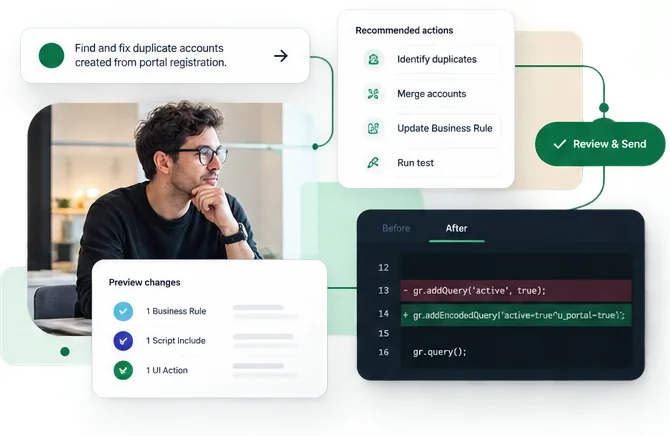
Illustration: a person in glasses pausing to think at a desk, with composed cards around them — a request reading Find and fix duplicate accounts created from portal registration, a list of recommended actions, a Preview changes card counting one Business Rule, one Script Include and one UI Action, a before-and-after code diff, and a green Review and send button.
RECEIPT 01 · WHAT IT ASKED YOUR INSTANCE
A tool card, while it runs.
QUERY · incident 0.38 s · 14 records
assignment_group.name=Network Ops^active=true^ORDERBYDESCpriority
  1. 1
    the status dotStatus, honestly

    Amber while the call is in flight, green when it returned. It is the same dot the product uses everywhere: amber is pending, green is a thing that happened.

  2. 2
    QUERY · incidentWhich tool, and which table

    Named from the catalog the agent chose from, so you can match what you're seeing against the complete list of fifteen. A card that says QUERY cannot have written anything.

  3. 3
    0.38 s · 14 recordsReal timing, real count

    How long your instance took and how many rows came back. Fourteen records means the answer above it was computed from fourteen records — not from a model's recollection of your data.

  4. 4
    assignment_group.name=Network Ops^…ServiceNow's own encoded query

    Not a paraphrase. The literal string sent to your instance, in the syntax your admins already write by hand. Copy it into a list view and you will get the same rows.

Cards appear inline in the conversation, in run order, before the answer that used them. You watch the agent work rather than reading a summary of the work afterwards.

RECEIPT 02 · WHAT YOU APPROVED
An audit line, after the click.
comments · INC0048291 · 2026-08-30 14:32:08 · approved and sent by dana.whitfield
  1. 1
    commentsThe field that changed

    Named exactly. A customer-visible comment and an internal work note are different fields and the line says which — the distinction people actually get wrong under pressure.

  2. 2
    INC0048291The record

    One record. Every action in the catalog touches exactly one, so there is no such thing here as a bulk update you have to reconstruct afterwards.

  3. 3
    2026-08-30 14:32:08When it committed

    The moment the write landed, not the moment the draft was generated. Those are different times, and the gap between them is a person deciding.

  4. 4
    approved and sent by dana.whitfieldWho approved it

    A named human, and the same name your instance recorded in sys_updated_by, because the call ran on that person's own credentials. There is no service account to point at.

This line is Kaddiya's copy of the event. Your instance wrote its own, in its own audit tables, at the same instant — and that one is the record of truth. Ours is for finding things.

RECEIPT 03 · WHAT IT COST
A cost line, per turn, in cents.
≈ $0.011
one answered question, reply drafted
claude-sonnet-5 · in 1,842 · out 486 · cached 12,288
  1. 1
    claude-sonnet-5The model, named beside its own number

    A cost figure whose model is a paragraph away is a figure nobody can check. The model that produced these tokens is on the same line as the tokens.

  2. 2
    in 1,842 · out 486Tokens in and out

    The actual counts your provider billed for this turn, reported back by the API, not an estimate from a word count.

  3. 3
    cached 12,288Cache reads, separately

    Priced differently from fresh input, and usually most of the volume — which is why a turn that reads twelve thousand tokens of context still costs about a penny.

  4. 4
    the dollar figureComputed, never written down

    This figure comes from the same function the console runs, over these exact tokens, at your configured model's price. A test in the repository fails the build if the number on this page and the number that function returns ever disagree.

Billed to you by your provider at their published rates — we never hold your model key, so we could not meter you even if we wanted to. What connects today.

WHAT IS KEPT, AND WHERE
Three receipts on screen. Here is what survives the session.
  Where it lives How long
Queries it ran WhereIn the conversation, in Kaddiya. How longAs long as you keep the conversation. Delete it and they go.
Writes you approved WhereYour instance's own audit tables, plus an append-only log in Kaddiya. How longYour instance's copy is yours and outlives us entirely.
Your OAuth token WhereThe session, encrypted. How longThe session. Sign out and it is gone — there is no durable token, because nothing runs when you're away.
Instance data it read WhereThe conversation you were having, and nowhere else. How longIt is never copied into a shared index, a training set, or another customer's context.
Notes about your instance WhereKaddiya's notebook, never ServiceNow. How longOnly if a human kept it. An unkept note is never used again.